What Does a Media Buyer Actually Do, and Why Does It Matter for Your ROI?
A media buyer is one of those marketing roles everyone talks about, yet few people can clearly define. You may have heard the term in a meeting, seen it in a job description, or been told your business needs one. But beyond the buzzword, what does a media buyer actually do?
Published: June 2026 | Category: Media Buying | Reading Time: 6 min
You have heard the term. Maybe someone pitched you on it, or you saw it in a job description, or a marketing consultant mentioned that what you really need is "a media buyer." And you nodded along, because it sounded important.
But if someone asked you right now to explain what a media buyer actually does on a Tuesday afternoon, you might struggle to give a clean answer.
That gap matters. Because if you do not understand what the role involves, you cannot evaluate whether you need one, what to look for when hiring, or why your current ad results might be underperforming.
This article closes that gap.
The Simple Version First
A media buyer is the person responsible for deciding where, when, and how much money gets spent on paid advertising, and then making sure that money performs.
That is the one-line version. The full picture is more involved.
What Media Buying Actually Involves
The term sounds like it is about purchasing. In the traditional advertising world, it literally was. A media buyer's job was to negotiate and purchase ad space in newspapers, on television, on billboards, and on radio. You had inventory. You had rates. You had placements. You bought them.
In digital advertising, the mechanics are different but the core responsibility is the same: put the right message in front of the right person at the right cost, and make sure the outcome justifies the spend.
Here is what that looks like in practice across a modern campaign.
Strategy and Platform Selection
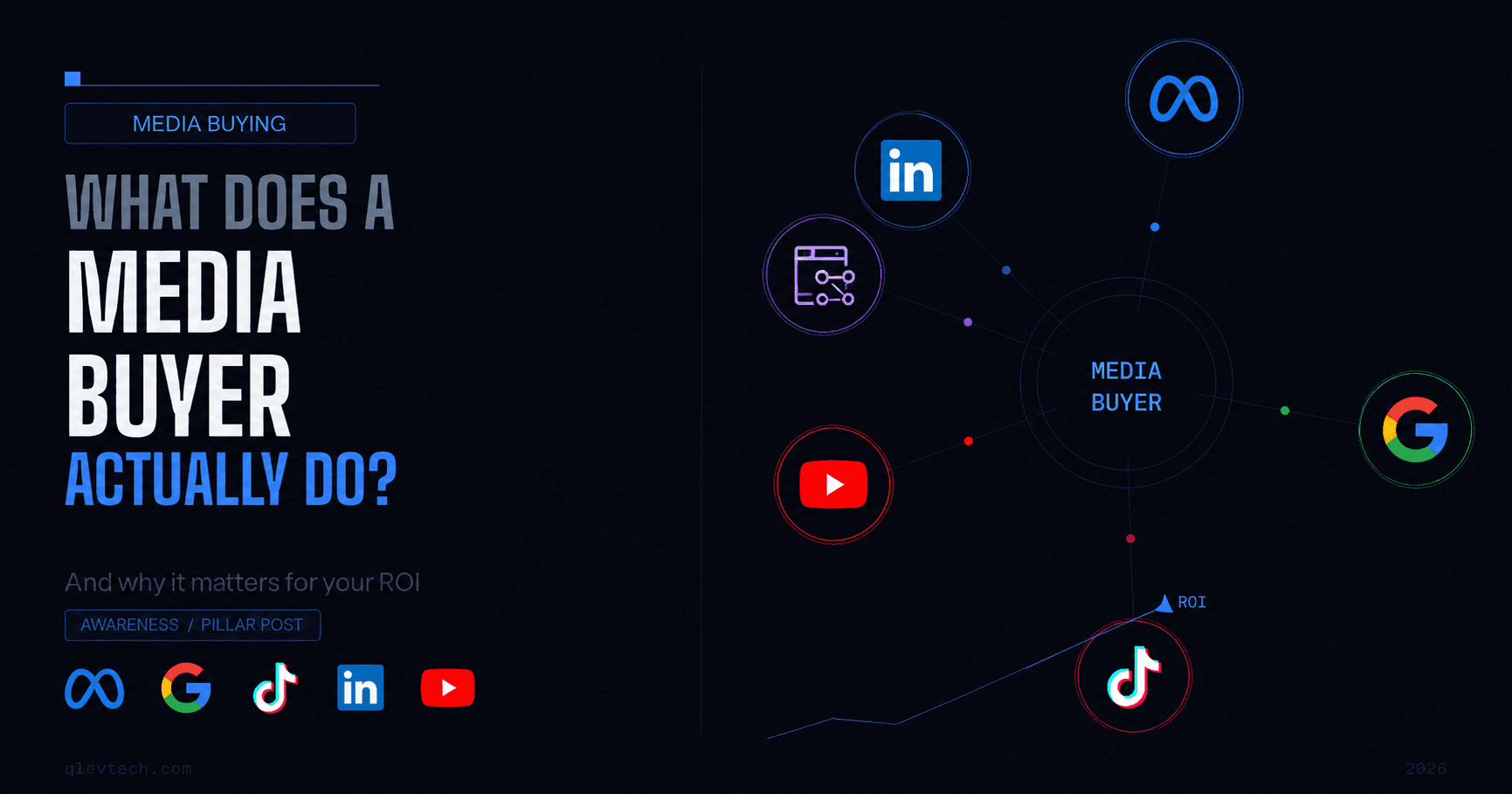
Before any ad goes live, a media buyer works out which platforms make sense for the specific business and campaign goal. Meta (Facebook and Instagram), Google Search, Google Display, YouTube, TikTok, LinkedIn, programmatic networks, and others each have different audience profiles, different cost structures, and different strengths.
A media buyer does not run everything everywhere. They make a case for where your budget will generate the best return given who you are trying to reach and what you want them to do. Running LinkedIn ads for a consumer product aimed at students would be an expensive mistake. Running TikTok ads for a B2B enterprise software product would be another. Platform selection is a strategic decision, not a default.
Audience Research and Targeting
Once the platforms are decided, a media buyer builds out the audiences. This means identifying who should see the ads based on demographics, interests, behaviors, job roles, geography, purchase intent signals, and existing customer data.
In 2026, with privacy changes having reduced the precision of third-party data, audience strategy also includes building first-party audiences from your own customer lists, website visitors, and engagement data, and using those as the foundation for finding new customers through lookalike and broad audience modeling.
Poor audience targeting is one of the top reasons ad campaigns waste money. Reaching people who would never buy, or reaching buyers with a message that does not match where they are in their decision process, drives up costs and drives down results.
Budget Allocation and Bid Management
A media buyer decides how budget gets distributed across campaigns, ad sets, and platforms, and then actively manages how the system bids for ad placements.
This is more nuanced than it sounds. Platforms like Meta and Google use automated bidding systems that optimize toward the goal you set. Set the wrong goal, give the system the wrong signals, or structure your campaigns in a way that confuses the algorithm, and the automation works against you instead of for you.
An experienced media buyer knows how to structure campaigns so the algorithm has what it needs to optimize well, when to let automation run, and when to override it manually.
Creative Direction and Testing
Advertising creative includes the images, videos, headlines, and copy that make up the actual ad. A media buyer is not always the person designing the creative, but they are always involved in directing it.
That means briefing the creative team on what kind of content tends to work on each platform, what hooks to test, what messaging angles to explore, and how to format assets for each placement.
They also run structured creative tests to find out which versions of an ad outperform others. The difference between a 1% click-through rate and a 3% click-through rate on the same budget is a meaningful difference in leads and revenue. Testing is how you find that difference.
Performance Monitoring and Optimization
Once campaigns are live, a media buyer watches the data and adjusts. This is continuous, not occasional.
Optimization includes pausing underperforming ad sets, reallocating budget to what is working, refreshing creative before fatigue sets in, adjusting audiences, testing new angles, and troubleshooting drops in performance when they happen.
Without this layer of active management, campaigns that started strong plateau and decline. The platforms do not fix this for you. The media buyer does.
Reporting and Attribution
A media buyer connects what the ads are doing to what is actually happening in the business. Not just impressions and clicks, but leads, calls, purchases, and revenue.
They also navigate attribution, which in a post-iOS, multi-platform world is genuinely complicated. When a customer saw a YouTube ad, then a Meta retargeting ad, then searched on Google before buying, which channel gets credit? How do you measure performance without reliable last-click data?
A good media buyer builds the reporting infrastructure to answer these questions clearly, so budget decisions are based on actual business outcomes rather than vanity metrics.
Why This Matters for Your ROI
Most businesses that run ads themselves, or hand the job to someone without deep platform expertise, make the same set of mistakes. They boost posts instead of building proper campaigns. They run one ad creative for months without testing anything new. They optimize for clicks instead of conversions. They send paid traffic to a page that was not built to convert. And they measure success by looking at the platform dashboard without connecting it to actual revenue.
These are not small inefficiencies. They are the difference between ads that generate a predictable return and ads that drain budget with nothing to show for it.
A skilled media buyer does not just run your ads. They build a system around your ads: the strategy, the structure, the creative direction, the testing, the tracking, and the ongoing management that turns paid media from a gamble into a growth channel.
What to Look for in a Media Buying Agency
If you are considering working with an agency or consultant, here are the questions that actually matter.
What platforms do they specialize in? Generalists exist, but depth matters. If you need Meta and Google, make sure those are genuine areas of expertise, not just services they list on a website.
How do they measure and report results? If the answer is clicks and impressions, keep looking. The answer should be cost per lead, cost per acquisition, return on ad spend, and how those numbers connect to your revenue.
What does their creative process look like? Ads live and die on creative. An agency that cannot articulate how they develop, test, and iterate on ad creative is missing a significant part of the job.
What is included in the monthly management fee? Strategy, reporting, creative direction, and active optimization should all be accounted for. Know what you are paying for.
Can they show real results from accounts similar to yours? Not case studies that are light on numbers. Actual performance data from campaigns in your industry or with similar budget levels.
The Honest Summary
Media buying is not a magic button. It is a discipline. Done well, it is one of the most reliable ways to grow a business with a proven offer. Done poorly, it is an efficient way to spend money without seeing returns.
The difference between those two outcomes almost always comes down to the quality of thinking behind the campaign, not the size of the budget.
If your current ads are not delivering the returns you expect, the problem is usually not the platform. It is the strategy, the structure, or the execution.
At QLEVR, we manage paid media campaigns built around proper strategy, creative that is tested and refreshed, and reporting that connects your ad spend to actual business results. We work with founders and business owners who are done guessing and want a system that performs.
Talk to us about your paid media goals
- If you are building your foundation first, start with our 2026 guide on SEO