Your Website Is Quietly Losing You Clients in 2026. Here’s Why.
Most business websites fail the same way. They were built to impress the owner, not convert the visitor. That gap is costing businesses more than they realize
Published: May 2026 | Category: Website Design | Reading Time: 7 min
You built a website. Put real money into it. Shared the link. And somewhere between launch day and right now, you stopped expecting it to do anything.
The leads are not coming. The bounce rate is rough. And every time someone asks “do you have a website?” you say yes, then quickly change the subject.
Most business websites fail the same way. They were built to impress the owner, not convert the visitor. In 2026, that gap is costing businesses more than they realize.
Visitors Decide in 3 Seconds. What Are They Deciding About Yours?
Behavioral research from the Nielsen Norman Group puts the average first impression window at under three seconds. In that window, visitors are not reading your copy. They are not watching your video. They are deciding whether or not you are credible.
A slow load kills it. A cluttered layout kills it. A hero section that says “Welcome to Our Website” instead of telling someone immediately what you do and why it matters to them, that kills it too.
Most businesses respond by swapping colors or changing fonts. They are treating symptoms. The real problem is structural: the site was built around what the business wants to say, not what the customer needs to hear.
What Good Design Actually Means in 2026
The definition of a high-performing website has shifted a lot. It is no longer about aesthetics alone. In 2026, good website design means three things working together.
Speed That Does Not Make People Wait
Google’s Core Web Vitals are a confirmed ranking factor. A site that loads in more than 2.5 seconds on mobile is not just frustrating, it is penalized. With over 63% of global web traffic coming from mobile devices, a desktop-first design is a handicap you are choosing to carry.
A well-built website today is optimized for Largest Contentful Paint under 2.5 seconds, built for a near-zero Cumulative Layout Shift score, and hosted on infrastructure that does not buckle under real traffic.
Clear User Journeys, Not a Maze
Every page of your website should answer one question at a time and move the visitor toward one next step. Not five. One.
The most common design failure is not bad colors. It is decision paralysis. Too many calls to action. Too many navigation items. A homepage that tries to say everything and ends up landing on nothing.
A conversion-focused site maps the customer journey before a pixel is placed. Who lands here? What do they need to believe before they act? What is the single thing we want them to do next? That thinking shapes everything.
Trust Signals in the Right Places
In a market where AI-generated websites are everywhere, real credibility markers matter more than they ever did. Client reviews, case studies, team photos that look like actual people, logos of businesses you have worked with. These are not decoration. They are often the difference between a visitor staying or leaving.
A well-designed site places those signals near the moments where someone is close to a decision, not buried in a footer no one reaches.
What a “Cheap” Website Actually Costs You
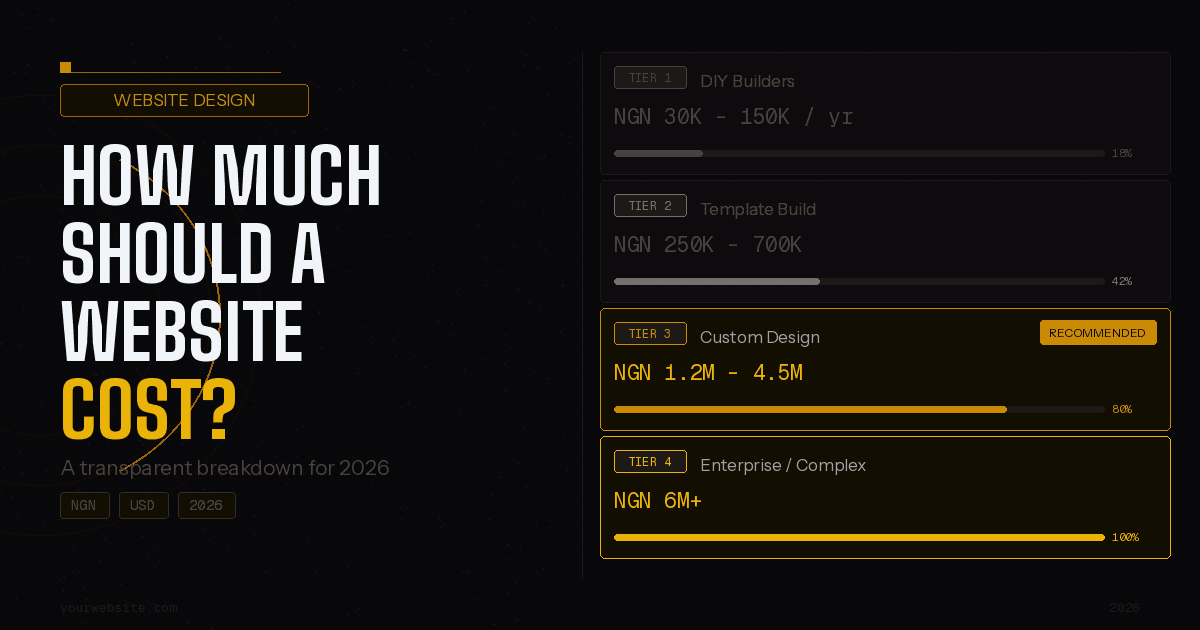
A lot of businesses go the DIY route or opt for a low-budget template. The upfront spend feels manageable. The long-term cost does not show up on an invoice, so it stays invisible.
Think about what a poorly converting website does to your numbers over time. If your site converts at 1% instead of 3%, you are leaving two-thirds of potential clients on the table every single month. That is not a rounding error. That is real revenue you are not seeing.
It gets worse when paid ads enter the picture. Running Google or Meta campaigns to a weak website is like filling a bucket with a hole in it. Your cost per acquisition climbs and the ads take the blame for a problem the website created.
And because Google rewards pages with low bounce rates and strong engagement, a poorly designed site suppresses your organic rankings even when your content is solid.
The math is not complicated. A well-designed website is not a cost. It is the thing that makes everything else you spend on marketing actually work.
What a Real Website Redesign Process Looks Like
A proper design process in 2026 does not start with templates. It starts with your business and works backwards.
Discovery. Who is your customer? What are they already searching for? What doubts are they carrying before they buy?
Architecture. How do pages need to be structured so visitors find what they need without running into friction?
Copywriting. What does each page need to say, in what order, to move someone from skeptical to ready?
Design and Build. Visual work that reflects your brand and is built for conversions, not just to look good in a screenshot.
Testing. Heatmaps, click tracking, and real data to show what is working instead of guessing.
That is the difference between a website that looks nice in a portfolio and one that actually does its job.
Your Website Should Be Your Best Salesperson
The businesses growing fastest right now are not always the ones with the biggest ad budgets. They are the ones with websites that work around the clock. Answering questions. Building trust. Turning strangers into paying clients without needing a sales call every single time.
If your current site is not doing that, it is not just a design problem. It is a business problem.
We build websites designed from the start to convert visitors into clients, fast, built for performance, and ready for what 2026 actually demands.
Want to drive more traffic to your new site? Read our guide on SEO in 2026 and how media buying can accelerate your growth.